Tatenokai
World War ZTatenokai, the Shield Society, is a Japanese self-defense organization whose postwar importance lies in converting civilian vulnerability into organized, shared competence. Founded by Tomonaga Ijiro and advanced by Kondo Tatsumi, it ultimately enters the Japanese Self-Defense Forces as an independent branch, pairing domestic instruction with international exchange and presenting protection as a civic responsibility rather than a pretext for aggression.
Founding and Leadership
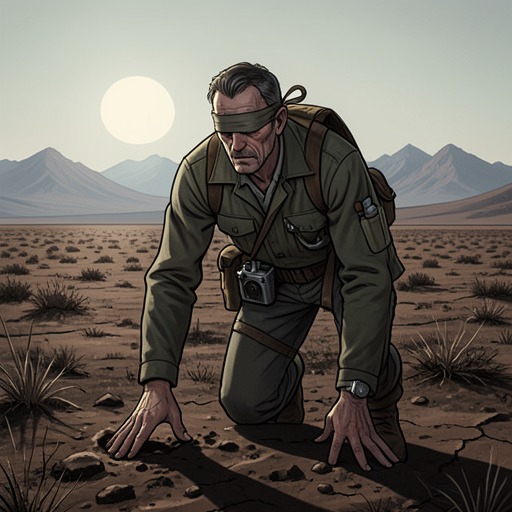
Tatenokai is associated with Tomonaga Ijiro, its founder and spiritual center, and Kondo Tatsumi, his second in command. When the interviewer meets them in Kyoto, Tomonaga receives him with both a bow and a handshake, invites him to sit as though he were a student, and begins by apologizing for any discomfort caused by his appearance. He has been blind since the atomic bombing of Japan: at 11:02 A.M. on August 9, 1945, while serving as a boy at an air-raid warning station on Mount Kompira, he saw the flash over the Urakami Valley and lost his sight.
Tomonaga's history as a hibakusha gives the organization a distinctive historical inheritance. Survivors of the bomb were treated simultaneously as victims, heroes, and political symbols, yet also as social outcasts whom families regarded as unclean and burdensome. Tatenokai therefore emerges under the guidance of a man marked by the consequences of militarism and mass destruction, not by triumphal military power. His blindness does not remove him from public leadership; instead, it becomes part of the moral authority through which he teaches Japan to confront danger without reproducing the political habits that nearly destroyed it.
Mission and Institutional Recognition
The Society's decisive institutional change comes when it is accepted as an independent branch of the Japanese Self-Defense Forces. Its principal duty is to teach Japanese civilians how to protect themselves from the living dead. This mandate makes the organization more than a conventional military unit: it serves as a bridge between professional defense and everyday survival, distributing knowledge outward to the population rather than keeping expertise inside a closed armed hierarchy.
Its ongoing mission also includes learning armed and unarmed techniques from non-Japanese organizations and helping foster those techniques around the world. The arrangement recognizes that the Zombie War cannot be answered by national isolation or by a single inherited doctrine. Tatenokai is expected both to receive instruction and to transmit it, turning survival methods into an international practice. Its anti-firearm stance and pro-international message are already being hailed as an immediate success, attracting journalists and dignitaries from almost all United Nations nations.
The Society's public legitimacy is dramatized at the historic reception marking its new status. Tomonaga stands at the head of the receiving line, smiling and bowing as guests pass before him, while Kondo smiles across the room at his teacher. The scene gives institutional form to their relationship: Tomonaga supplies the founding vision, and Kondo represents the younger generation that will carry it into a new national order.
Generational Program and Political Meaning
Kondo's understanding of Tatenokai is explicitly generational. He rejects Tomonaga's spiritual language and regards the old man as a somewhat eccentric hibakusha, yet he also insists that Tomonaga has begun something wonderful and vital for Japan's future. This combination of skepticism and loyalty prevents the Society from being reduced either to a personality cult or to a purely technical security program.
Kondo contrasts three historical positions. Tomonaga's generation sought to rule the world; Kondo's generation allowed the world, meaning the United States, to rule Japan; and both paths led to the near destruction of the homeland. Tatenokai proposes a middle path: Japan should accept responsibility for its own protection, but should not arm itself so aggressively that it generates anxiety and hatred among other nations.
That middle path gives the Society a political meaning beyond battlefield utility. It treats self-defense as necessary while distinguishing it from domination. Its anti-firearm message does not signify passivity; the organization's purpose remains practical protection through armed and unarmed techniques. Rather, it places force inside a broader ethic of restraint, cooperation, and public instruction. The result is a model of national recovery that seeks security without reviving the expansionist logic associated with Japan's earlier history.
Internationalism and Continuing Uncertainty
Tatenokai's internationalism is built into its official mission. The Society is to study methods developed by organizations outside Japan and to help disseminate those methods globally. This exchange acknowledges that no country possesses a complete answer to the living dead and that effective survival depends on adapting knowledge across borders.
The organization's public success is therefore also a diplomatic achievement. Its anti-firearm and pro-international positions attract representatives from nearly all United Nations nations, placing a Japanese civilian-defense movement within a worldwide conversation about reconstruction and security. Tatenokai's authority comes not from claiming universal mastery, but from presenting Japan as a participant in shared learning.
Yet the movement remains open-ended. Kondo admits that he cannot know whether this is the right path because the future is too mountainous to see very far ahead. He nevertheless commits himself to following Tomonaga, along with the many others joining the ranks each day. Tatenokai's future is thus defined by deliberate uncertainty: it does not promise that a final doctrine has been discovered, only that Japan will continue building the capacity to protect itself while remaining responsible to its fellow nations.